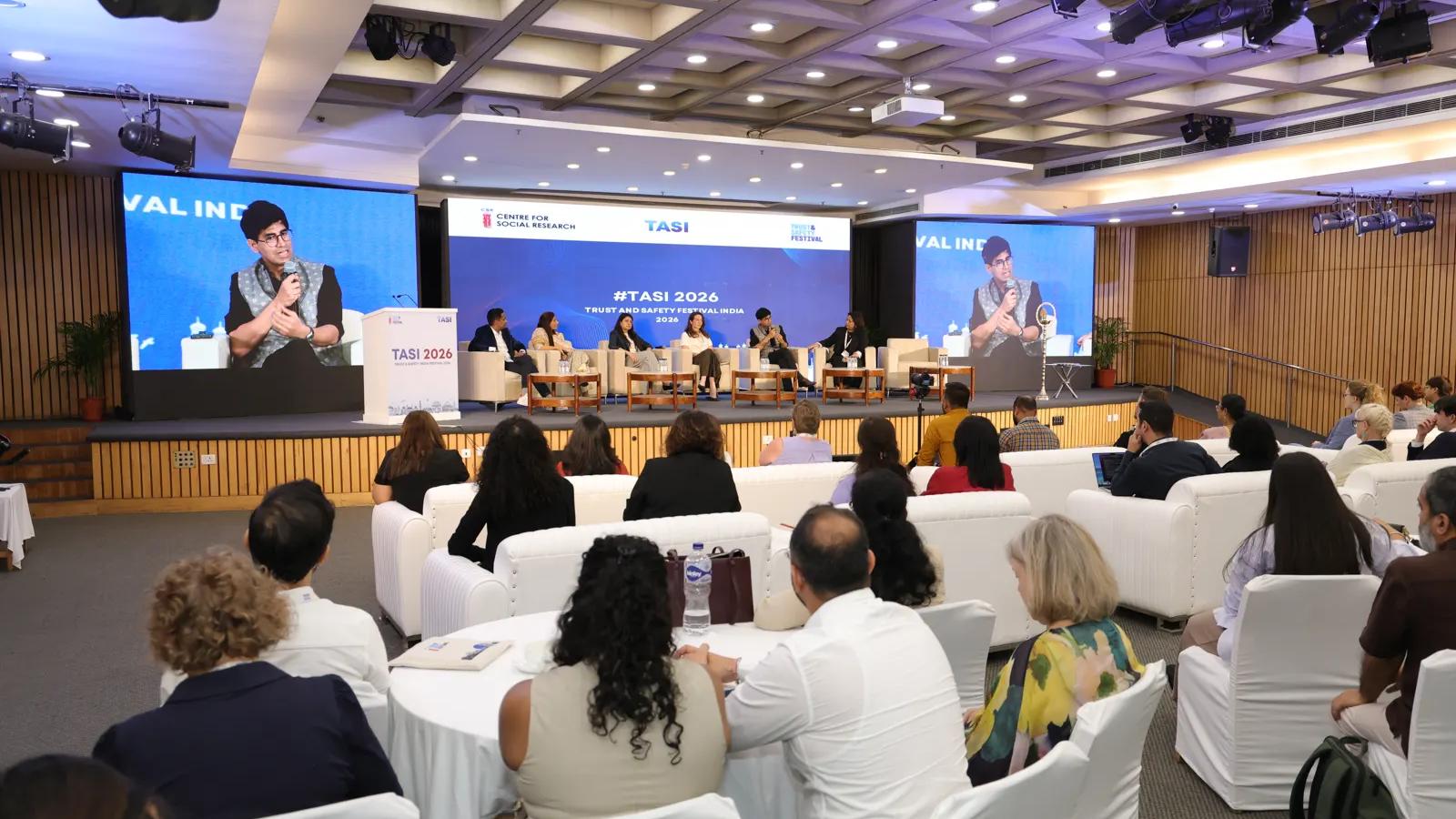
The second Trust and Safety India Festival (TASI 2026) took place in New Delhi from 13 to 15 October 2026. An opening reception at the Goethe-Institut on the evening of the 13th was followed by two days of sessions in three rooms at the India International Centre: the Main Hall, the Workshop Room and the Roundtable Room. The Centre for Social Research (CSR) organised it with the Trust and Safety Festival, under the theme People First. Safety Always.
Around 500 people came, and more than 100 speakers took part in over 50 sessions. A minister and ambassadors sat beside platform policy teams, survivors' groups, journalists and creators, with researchers and students from India, Nepal, Sri Lanka, Kenya and Korea. The talk covered children and AI, age checks, women's safety, scams and trafficking, journalism, and how India should regulate platforms.
The inaugural address on 14 October set the tone. Jitin Prasada, Minister of State for Commerce & Industry and Electronics & IT, told the room the law would not do the industry's job for it.
“All these cyber securities, laws, regulations mean nothing. They'll be all on paper if the industry doesn't step forward and if you don't take responsibility, it means nothing.” Jitin Prasada, Minister of State for Commerce & Industry and Electronics & IT
Over the next two days the same question came back in different voices. When something goes wrong online, who owns it?
This recap follows the festival in the order it happened: the opening evening, then each day room by room, then what was launched, what the rooms asked for and what comes next.
A note on how to read what follows. Three sessions ran under the Chatham House Rule, so nothing from them appears here. Every quotation is word for word from the session recordings. Every figure a speaker gives is a claim made on stage by the person we name, and we have not checked them. The festival totals are the organisers' counts.
Opening reception, 13 October
The festival opened at the Goethe-Institut, hosted with the embassies of Germany and France, and both diplomats used their time to say the same thing in different words. AI brings real opportunity. It also puts children, women and marginalised groups at risk, and no single country can write the rules for it.
Georg Enzweiler, Germany's Deputy Chief of Mission, made the point with a small example. “A small bias in the data of the system can, when that system is used at a larger scale, affect millions of people,” he said. France's deputy chief of mission, Lisa Hamon, went wider: “digital safety cannot be designed successfully from one capital, one single industry, or one single continent.”
Dr. Ranjana Kumari, Director of CSR, told the room that TASI is a festival, not a forum, and that people in the Global South are the consumers of this technology in a big way. They should be in the room where its rules are written.
“We created those technologies, we retain the responsibility to shape their purpose.” Dr. Ranjana Kumari, Director, Centre for Social Research
Jyoti Vadehra of CSR then declared TASI 2026 open, and five short talks, the Safety Spotlights, followed.
Kunal Majumder of the Committee to Protect Journalists started with a story from his own early days. He was 23 or 24, reporting in Andhra Pradesh, when he watched a TV9 reporter get beaten. He got away on a police truck and lost his slippers on the way. What he took from it was not about bravery. “The thing is, I didn't really lack courage. What I lacked was preparation.” Safety, he argued, has four parts, physical, digital, legal and psychological, and it belongs in every assignment. Much of it costs nothing. CPJ is working with the Clooney Foundation and the Thomson Reuters Foundation on an AI-powered legal safety app for journalists on WhatsApp, due in India next year.
Lucy Thomas of PROJECT ROCKIT described a National Youth Collective of 50 experts aged 12 to 20. They have worked with Meta, Snapchat, Roblox and the Australian government, and they were paid more than 80,000 Australian dollars last year. She was clear about what that means. “And they're paid for that expertise, not in a gift certificate or a pat on the back, but in cold hard cash.”
Then Rescue Foundation took the room somewhere less comfortable. Khushi Panda and Gerard Mukhia described a year in which the organisation rescued more than 600 people in over 150 operations. Only 2% of those operations were in traditional brothels. “Shockingly in 89% of the cases, the trafficker was someone the survivor knew,” Panda said. In their survey of survivors, 81% were active on social media, mostly on Instagram. Fewer than half could change a privacy setting, and only 15% knew how to report harm online. Mukhia ended with a warning aimed at everyone else in the building.
“But most of what was said here today or will be said wouldn't be understood by most of our girls.” Gerard Mukhia, Director of Communications and Fundraising, Rescue Foundation
The last spotlight showed what sharing information can do. Lisa Morrison of the Tech Coalition explained Lantern, a programme that lets companies pass signals about offenders to one another. “Bad actors do not stay on one platform, right? They hop around platforms when they're trying to exploit children, and they do so really quickly.” She walked through a case. Meta uploaded signals after a law-enforcement alert. Block then found 18 Cash App accounts, and Microsoft found linked Xbox accounts. No one company could have seen all of it.
Day one, 14 October
Main Hall, morning
The Main Hall opened with Jyoti Vadehra setting out why anyone should be there. “Trust and safety is not about responding to what can go wrong, it is about helping create an internet and AI powered future where more can go right.” Her co-host Caroline Humer, one of the festival's founders, described what TASI is for: “The festival is here to have conversations with people that you never thought you would have because you didn't think they were in this space.”
Snigdha Bhardwaj of Google gave the opening keynote on young people and AI. A chatbot can explain a hard idea to a child, she said, “but then it should not pretend to be a person who loves them back.”
The opening panel, moderated by the journalist Faye D'Souza, began with a reminder of who pays first. Faye said it plainly: “it's women and children that get hit first and that get hit worst.” Nicky Jackson Colaco of Roblox wanted platforms to stop treating safety as a takedown job and start asking about intent, such as whether a user is trying to move a child off one platform and onto another. She was also direct about age. “We live in the age of AI. We can age verify. I think the age of self-declared age should be over.” And she said who the defaults should be built for: “But who we solve for should not be the parents that have the capacity, the language skills, in some cases the education to use parental control tools.”
Rohit Kumar of The Quantum Hub brought the argument back to India's law. “Like in India, for instance, one of the biggest problems is our tech law essentially relies on safe harbor, which basically means that I'm only looking at third party content.” Pragya Misra of OpenAI said that when OpenAI cannot predict a user's age it defaults to the under-18 experience: “we are always veering towards the under 18 experience when we can't really predict the age because we want to give people by default a safer experience.”
The sharpest moment came when Faye turned the question around and asked who, inside a company, asks whether something is good for people before it launches. She raised camera glasses as an example. Rohit's answer was blunt. “Good for society is subjective,” he said, and he pointed to what such products can mean for blind users. The question stayed open.
Rahul Fernandes then announced Newslink, a 20-minute daily classroom practice that uses one news item to build critical thinking and kindness. At the opening reception the night before, he had given his reason for building it: “keeping children safe is half the job, but can we give them the tools, can we help them build skills that will help them be safe when no one's watching.”
Minister Prasada's inaugural address followed. India's AI Mission, he said, had trust and safety as a pillar, and its targets for 2026 were met. They are also already obsolete. India chose not to over-regulate AI, and it has now started to explore regulation that is human-centred and protects women and children. He pointed to the ban on online money gaming as one example, and he warned that deepfakes can swing elections. Then came the line at the top of this piece. He said the government was ready to hear the festival's views, and he asked for TASI's ideas to reach it.
Barkha Dutt moderated Growing Up Digital with speakers from Snap, Roblox, Netflix, PROJECT ROCKIT and the National Commission for Protection of Child Rights (NCPCR). Uthara Ganesh of Snap framed the stakes: “I do think that digital spaces are a critical part of young people's social infrastructure.” Laura Higgins of Roblox described Sentinel, a grooming-detection tool the company has open-sourced to other platforms. Dr. Sanjeev Sharma, NCPCR's Member Secretary, made the day's most concrete announcement. “What we are doing at NCPCR, we are developing an AI based tool which will be proactively able to detect the CSAM floating around on internet,” he said, with access for every state police force. Guidelines for platforms, he added, are coming very soon.
Lucy Thomas had the line that cut closest. “But I don't think we're the right people to be fixing the problems that we created.” She was talking about the adults who built today's platforms, and her point was that young people should lead the fixes. Barkha Dutt signed off the panel with an instruction. “Please go out and watch somebody you don't agree with. Please go out and read somebody you don't like.”
Karuna Nain then moderated a fireside on the fight against child sexual abuse material with Lisa Morrison of the Tech Coalition and Madeline Shepherd of Microsoft. Morrison said Tech Coalition members advanced 317 safety milestones in 2025, more than double the year before, and that Lantern now has 41 companies, with more than 2 million signals shared and more than 350,000 enforcement actions in under three years. Shepherd reminded the room who the offenders usually are: “the sad reality is that the majority of abuse cases are perpetrated by someone that the child knows or has a connection with.” Karuna proposed an on-site child safety hackathon at the next TASI.
Two short spotlights followed. Microsoft and Cyberlite introduced Behind the Chat, built with 131 students in nine schools in India and Singapore. Nina Bual of Cyberlite described a classroom where the harm is no longer abstract: “But the deepfake is in their classroom. They are seeing the effects of AI manipulation because of the girl who's been affected in class.” Then Snap launched My Digital Wellbeing Journal for 13 to 18 year olds, with five steps, Notice, Feel, Pause, Connect and Choose. Uthara Ganesh was careful about what it can do. “It's a journal. It's not going to solve all the challenges of growing up online, certainly not.”
Main Hall, afternoon
The afternoon began with the age assurance panel, moderated by Kamesh Shekar. If one subject followed the festival from room to room, it was how to know a user's age without turning the internet into an identity check. Omari Rodney of Yoti drew the line firmly. “If you're doing an age check, you're really doing an age check and you're not doing an identity check by stealth.” Siddharth P of the RATI Foundation brought the reality of Indian homes. In a RATI survey of 1,200 children, he said, 60% use shared devices. Then he described how easily a gate fails. “Can I go to a local store? And pay 50 bucks and that uncle is gonna pose as my parent and I can sort of age verify myself right?”
Industry, in turn, had to answer for its own tools. Kavitha Kunhi Kannan of Roblox described selfie-based age estimation introduced in February 2026 and was straightforward about the limits: “Like I said, the accuracy being 80% therefore means that there could be enforcement slips, which means that the age may have been estimated incorrectly.” Keemin Ngiam of k-ID said he had heard the threat that companies would leave small markets rather than comply. “Sometimes the conversation is, look, your market is too small. If you force me to go tell my product team to do this, we will pull out of the market, right?” He argued for reusable age tokens and announced that k-ID had opened its regulatory database, Nemo, to the public the day before.
Youth in Play, a CSR and Roblox project, put children in charge of designing safer online gaming. About 120 students in Bengaluru and Goa took part. Over 80% said they feel safe online. Only about 8% said they would go to a trusted adult when something goes wrong. Dr. Priyanka Bhalla of Roblox read it as a request: “a lot of the young people actually want autonomy when it comes to the tools to be able to manage both their privacy and their interactions with other people on the platform.” The students' own ideas were practical. A trusted-contacts list. An “Are You Sure?” alert before a scam link. A prompt that lets a bystander back someone up.
On the women's safety panel, moderated by Natasha Jog, the first speakers described tools that work. Sophie Mortimer of StopNCII.org explained that images never leave a person's device and only a hash is shared. The panel's point was about everything tools like that cannot reach. Uma Subramanian of the RATI Foundation said 2024 NCRB data records just 3,288 cybercrime cases against women, 3.2% of the total. Then she described what reporting costs. “The minimum time taken in a city like Mumbai is anywhere between 8 to 12 hours.” One survivor she knew needed 18 months of crisis counselling. Professor Ji-yeon Lee of Hankuk University of Foreign Studies spoke about a harm no case count captures. “The fear of it could happen to me is strong enough to change their daily behaviors both online and offline.” Women who have never been targeted still stop speaking up.
“The second part is if we can go easy on individual users and really demand accountability from systems.” Uma Subramanian, Co-Founder and Co-Director, RATI Foundation
Mortimer agreed. “It's a really important pivot, isn't it, from putting the burden on women to protect themselves to shifting it to the system, because the system should be protecting everybody.” Ai Sasaki of the Asia Women Leaders Forum followed with closing remarks for the afternoon: “Women should never have to choose between safety and freedom.”
Himadri Sarkar of TP, speaking in a sponsor spotlight, treated fraud, sextortion and trafficking-linked scams as a single business. He told of a retired man in Mangaluru who lost ₹2 crore 7 lakh to a call from someone in a fake uniform. India lost ₹22,495 crore to cyber fraud last year, he said, against ₹551 crore four years earlier, and 76% of it was investment fraud. His diagnosis was about speed. “One truth across all markets that I have witnessed is attack scales with compute. While review still scales with headcount.” And his conclusion was a design principle:
“Digital safety is not a moderation problem. It's an early warning signal problem.” Himadri Sarkar, Chief Solutions Officer, TP
The Main Hall's last scheduled session of the day was a fireside on the future of connection. Kevin Lee of Yuvaa spoke with Yoel Roth of Match Group and Dr. Kumari. Roth shared survey results from Indian singles: “about 60% of Indian singles said that while they feel very connected to other people online, they feel deeply lonely offline.” About 60% also said safety decides which dating app they choose. Roth said Tinder's Face Check adoption in India is more than 20 times lower than in other markets, and that the fix is not a law. “That's not something that requires regulation. It's something that requires ultimately will and coordination by the people in this room.” Dr. Kumari put the frustration plainly. “We are running behind the technology. We are not at the top of the table. We are not defining what and direction the technology should take. We are just kind of following.”
Workshop Room
The Workshop Room ran five sessions on day one. A panel on digital wellbeing across generations, moderated by Ruby Dhingra of Saksham Senior, argued that regulation which fixes on teenagers forgets another group. “Today a lot of regulation across the globe is focused on teenagers, for example. But when you start thinking of that, you're missing out on another demographic which is aging adults as well,” said Rajneel Kamath. Malti Jaiswal turned to banks: “I think banking system has a big responsibility and they've failed us miserably.”
Divya Chandra of BOOM ran a masterclass on spotting deepfakes. “Basically, if I have to put it in one line, every AI generated content is not a deepfake, but every deepfake is AI generated.” Voice cloning, she said, now needs only about three seconds of audio. “Unfortunately, fact checks don't go so viral. Misinformation does because of, you know, the kind of language it has, the emotions, etcetera.”
Abhilash Mallick of The Quint described ScamGuard, a chatbot that takes forwarded messages and replies in Hinglish. In five months it handled 222 conversations, with an average response time of 13 seconds. His reasoning was a change of tactic. “The idea was to be more proactive. We have spent enough time, two years, three years creating awareness, but now we have to also act in the moment.”
Another workshop went deeper into Newslink. There are no screens in the classroom, no logins and no ads, Rahul Fernandes said. “It's like no sugar, no carbs, equivalent.” Avneeta Bir, a principal in Mumbai, reported that 94% of pilot students would recommend it to other schools. The neuroscientist Nandini Chatterjee Singh reminded the room why one-size rules fail: “If there are 30 kids sitting in the classroom, we have 30 different brains in the classroom. They are not 30 copies of the same brain, okay?”
Roundtable Room
A morning panel in the Roundtable Room asked what happens when AI governance leaves women out. Shipra Baduni of Young Leaders for Active Citizenship described the familiar reflex. “If something is perceived to not be safe for usage, access is first taken away from women in the garb of trying to keep them…” Ramanjit of the Association for Progressive Communications offered a lawyer's view of why guidelines fail: “the worst kept secret in the world for general counsel in tech companies is that government regulation is a very useful way to get the engineers to actually listen.” Madeline Shepherd of Microsoft kept the focus on people. “People are more important than AI, and the whole point of building AI and leveraging it is to serve humanity. It's not the other way around.”
A roundtable on child safety in online social gaming took the age problem to the people who set policy. With real-money gaming banned and a national gaming authority in place, scrutiny is moving to social and casual games, and the room discussed what a shared code of practice for them could say. Dr. Sharma explained why NCPCR is moving fast. “Unless we address this, I actually fear because I am working in child-friendly bodies and the kind of complaints and the number of complaints we get, our entire generation will be wasted if we do not work on this.” A gaming founder made the shared-device problem vivid with one line: “Indian kids in that 90% families play on parents devices. So you suddenly have a 42 year old man playing Chhota Bheem.”
The sharpest request of the roundtable came from Chitra Iyer of Space2Grow, who shared research with about 700 children: 54% had faced harm online, 43% did not report it, and 55% of teens who spoke to a stranger went on to meet them offline. Then she put a challenge to every company present.
“Can we have next TASI all platforms who are here having a child safety report published?” Chitra Iyer, Co-Founder and CEO, Space2Grow
In the afternoon, a roundtable on raising children in the AI era looked at India's data protection law, which asks for verifiable parental consent in a country of shared phones. Mithat Hore of the British Asian Trust, which works across nine states, said: “The awareness in rural children still is abysmal. They really do not understand the concept of privacy. They're very open to just like accept friend requests, share data, share photos.” Kavita of Girl Effect said the idea of asking for consent breaks down in practice: “Nobody's going to ask for consent. Nobody's going to want to share it in the first place, so forget consent.” Riddhi Gupta of The Quantum Hub asked the group to look past content: “I think we over index on content based harms for example, bullying etcetera. But in the age of AI which we are discussing right now, especially in the context of children, persuasive interactions, unhealthy dependence on AI, all of those things also need to be accounted for.” The organisers plan to write a paper from the discussion.
A roundtable of fraud teams from Google, Adobe, Booking.com, Atlassian, Microsoft and ONDC compared notes on how the other side works. A Google participant gave an example. When fake alcohol-shop listings were taken down, “within a month, it moved from alcohol to daru, which was the Indic name for it, right?” A Booking.com participant described the adversary: “It's it's faceless, it's massive, it's global, and it's a problem that might require more advanced intelligence than what we currently have as as individual companies.” The group left with a proposal to form an informal working group and share signals the way child safety teams already do.
Day two, 15 October
Main Hall, morning
H.E. Marisa Gerards, Ambassador of the Netherlands, opened day two with a keynote that argued AI needs traffic rules, and that trust in AI and trust in journalism now travel together. She said the old rule of evidence no longer holds. “The expression, seeing is believing, I don't think it's true any longer nowadays.” And she said what was at stake plainly:
“Without a free press and the safety of journalists, our democracies are doomed.” H.E. Marisa Gerards, Ambassador of the Kingdom of the Netherlands
The journalism panel, moderated by Sonia Bhaskar, took that into the newsroom. Jency Jacob of BOOM described how the old excuse has changed. “The politician's favorite refuge was I was misquoted. Today the favorite refuge is that it's a deepfake.” He also made a specific ask: “I feel that fact checking has to be funded as a public infrastructure.” Suhasini Haidar of The Hindu had said early in the panel what she thinks journalism is for. “The mission of journalism is a public service. It is not a product.” Jency noted her reservations about productising anything. Vedanta Agarwal of Peek TV described the economics that keep newsrooms thin: “I don't want to be a newsroom that is always starved of resources. I want to pay my employees well.”
Saksham Senior, with the Indian Cyber Crime Coordination Centre (I4C) and Meta, launched a Cyber Awareness Month campaign for older people, and its founders told the room why earlier attempts failed. “For a long time that framing was that the senior is the victim. The senior is going to be cheated. And those videos just didn't work,” said Rajneel Kamath. So the micro-series “Main Scam Mein Nahi Aaungi” flips the script. The senior is the one who catches the scam. “Nobody wants to be lectured on Instagram or on social media where they come to seek entertainment,” said Ruby Dhingra.
The creators' panel, moderated by Aman Taneja, showed AI's two faces in one conversation. Ninad Raikar of the Indian Institute of Creative Technologies shared a surprise: “First time I saw AI creating jobs.” Urvashi Kapoor of Jagran New Media set out a disclosure rule: “if you have used AI to create something then the disclosure becomes mandatory because audience should know what they are consuming.” And she warned about the flip side. “AI scams don't just hack technology, they also scam human trust.” Maroof Culmen gave that sentence a face. A scammer had cloned the profile of an artisan he had featured and used it to post fake appeals for donations. Neha Agrawal said someone had recently written to tell her they had cloned her voice, and she suggested a low-tech fix: “You know, if anybody is trying to copy something, there has to be like a secret mutual code between us.”
Vivek Abraham of The Asia Group then asked Adam Seldow of Roblox how adults should respond to children who are always online. His answer was simple. “The most important thing you can do is ask and look what the kids are actually doing.” He had little patience for panic. “Let's not be scared. Let's be positive and let's ask questions like I said before.”
The morning ended with a spotlight from Girl Effect. Satviki Varma added a measure of whether a safety tool has done its job. “It's not enough for safety mechanisms to exist. It's equally and more important for young people to be empowered and to feel safe enough to use it.” Her colleague Shruti shared an observation from Girl Effect's campaigns on technology-facilitated violence: “men responded way better to other men speaking about tech-facilitated gender-based violence.”
Workshop Room
The Workshop Room opened with Dhruv Khosla of Everest Group and Akash Pugalia of TP describing what sits behind a safer AI model: people. Child-safety takedowns that took about three hours five years ago now take about one, Khosla said, because AI has improved. And still: “AI can provide you scale but whenever you require context, AI fails, right?” Pugalia described how model builders collect data. One lab asked for five or six second videos of people from Southeast Asia so that its AI could learn their faces. Progress, he added, thins out beyond the top 15 languages.
In a workshop on youth co-design, Nina Bual of Cyberlite said that when she presented the work abroad, people who design products for children told her something that stayed with her: “all of them said that they hadn't spoken to a child before they had designed a safety product.” Adults tend to assume the worst about why children are online, she said. “Children do not go to the internet for bad. Bad finds them.” Of the 131 students who co-designed Behind the Chat, a third said they were “less worried about losing their future jobs than losing their ability to think.” The resources are free and come in eight languages.
Kutunga's Caroline Makumbe presented a child-centred design framework rooted in African values, built from the voices of hundreds of children. “Our children are consuming technology. That does not factor in their identities, their needs, their culture, their heritage, and even their safety.” A video from the framework put the demand in one sentence. “Children should not have to adapt themselves to technology. Technology must be worthy of the child.”
A discussion on open-source AI between India and Germany followed. India runs on open source, but “open” has narrowed to open weights, and Tarunima Prabhakar of Tattle explained the catch. “Whatever red teaming evaluation you might do and whatever guardrail or foundational model might institute, those are very easily removed, right? That's the challenge with open models.” She also admitted what researchers still do not know: “Nobody here knows why is it that if you remove nudity from like your data sets, the overall performance of the model declines.” Ankit Bose of NASSCOM ended the session with an impatience many in the building shared. “I think enough again on frameworks and declarations and paperwork, right? It's time to act.”
The Workshop Room's last session of the festival was a guided journalling workshop for teens, led by Srishti of YILAC, with a ground rule that what is said at your table stays at your table. One teenage participant described how close digital life feels, and how little of it gets discussed at home: “we do not discuss with our parents because that's a taboo for them.”
Roundtable Room
The Roundtable Room opened with Madelaine Coelho of the University of Toronto, who presented research from more than 60 interviews with organisations across India. Her finding was that online and offline violence are one continuum. “Technology facilitated violence is often seen as happening because of technology, but that's not true. It's happening because of the same real world and structural barriers that fuel domestic violence in person.” Support services are split. Gender-based-violence services cannot do takedowns. Online-abuse services cannot do safety planning. And police often wave the problem away. Coelho shared a moment that made the point:
“I've had crisis counselors who when I asked the main question of, okay, are people also seeking a police, just laughed. Just like, why would they do that? And she's been in the field for 30 years.” Madelaine Coelho, PhD candidate, University of Toronto
Sophie Mortimer made the same case from the other direction: “I think it's really interesting that we're kind of still having to make the argument that on and offline are separate things. They're the same thing.” A participant, Sonali, argued that India's workplace harassment law already offers a better test than intent: “I think impact needs to be measured than the intent because intent can never be measured and justified.”
Kathmandu University researchers brought data from a place where the future had already arrived. In Nepali secondary schools, they found, students and teachers adopted AI well before institutions did. The researchers reported that 85.9% of surveyed students use AI, while only 12.5% of teachers have formal training. Dr. Rupa Munakarmi said teachers hid it at first. “They were trying to hide, like it was a crime to use AI.” Haribol Acharya shared two findings that fit together. Nepal's national AI policy, he said, “has been generated from the AI.” And students told researchers why they prefer a chatbot: “if they ask the questions to the teachers or their friends they might be judged but AI doesn't judge you based on your question so they feel easier to ask the questions to the AI chatbot.”
Ashwini Natesan described Sri Lanka's experience with platforms. Whether platforms comply with a country's online safety law, she said, is an economics question, and a small market loses it. “Content which has to be taken down takes over 3 weeks now and after 3 weeks when it's taken down there's absolutely no point in even taking down that content but that's the reality of it.” Her fix was narrow laws that fit human rights norms and a shared set of South Asian principles, which she was careful to separate from sharing anyone's data. “Just because you have a law widely worded, no tech company, nobody will come forward to comply with it.”
Dr. Abigail Bentley then showed why a definition can be the whole problem. In her study of survivors and experts in Pakistan, images that harmed women were often not explicit at all. A photo with uncovered hair. A woman sitting beside a man who is not her husband. The consequences she reported reached honour killings. “Nothing about the image itself has changed, but the context, the audience, the intent of sharing, the consent to share, and the potential harm are all completely different.” She asked whether a consent-based approach could work better than content categories. A card vote at the end came out mixed. “The legal people are firmly no.”
The Roundtable Room closed with a session on a shared South Asian approach to child online safety, which used video messages to carry the argument across borders. Pratishtha Arora of Social and Media Matters said: “Be it a child in Dhaka, Colombo, Kathmandu or anywhere in the globe, I feel these are some similar risks and our responses stay largely within national borders. But we need to realize offenders and harm doesn't.” Anil Raghuvanshi of ChildSafeNet in Nepal said what the whole festival had been circling: “The question is not whether we can work together. The question is whether we can afford not to.” The facilitator said he would put together a draft framework with five areas and share it with the people concerned. “There is no owner for this,” he said.
Main Hall, afternoon
The afternoon opened with the trafficking panel, moderated by Smita Mitra, which brought together Impulse, Rescue Foundation, Just Rights for Children and the Ministry of Home Affairs. Hasina Kharbhih of Impulse described why enforcement and technology keep missing each other: “So we have the enforcement who don't understand how the technology work. We have technology who's telling them this is happening. So these are two foreign languages that they are speaking.” Ravi Kant of Just Rights for Children said 46,000 to 47,000 children go missing in India every year, and he gave one local example. Five girls in Class 8 and 9 in Malda were groomed by people posing as K-pop members. He added: “I don't know whether it is helping combat trafficking or not, but I do know that that technology is enabling traffickers. It is giving them anonymity.” He also took on the privacy argument directly: “But right to privacy does not mean that impunity from prosecution.” Manoj Kumar Meena of the Ministry of Home Affairs asked platforms to look at their own revenue.
“We should control the advertisements for such cyber-facilitated gender-based violence or recruiting. Yeah, I mean. Let's not earn from the advertisements of such things.” Manoj Kumar Meena, Indian Cyber Crime Coordination Centre, Ministry of Home Affairs
A fireside on navigating social media across a generation gap brought a parent's view and a young creator's view to the stage. Actor Shruti Seth, whose 12-year-old has no phone, gave the best instruction of the festival: “please understand you run the algorithm. Don't allow the algorithm to run you.” Creator Pari Dua, who is 23, said what many teenagers feel: “but now the teenagers I feel like their sense of identity and self worth is now tied to Instagram or Facebook.”
Rohit Kumar's day-one question about safe harbour got its full answer when The Quantum Hub launched its report, Designing for Online Safety: Reimagining India's Digital Service Regulation. It took about two years and drew on nearly 50 stakeholders. The report proposes classifying services by what they do, a three-part test for systemic risk, and a duty of care with penalties for failing to redesign, while keeping safe harbour in place.
“Not how do you regulate more, but how do you regulate better?” Rohit Kumar, Founding Partner, The Quantum Hub
He explained why litigation alone fails. “Getting platforms to face more litigation, which is content by content, is not going to force them to redesign. What you need instead is penalties for lack of redesign, which is called a duty of care approach.” Dr. Kumari, on stage for the launch, called for a response that fits countries like India. “Time has come that we cannot be having a European response and American and Australian, you know, all these complicated laws which are coming.”
The closing plenary put the biggest questions to the people with the most power over the answers. Sayoni Aiyar of The Indian Express moderated, with Amlan Mohanty of Anthropic, Rajesh Ranjan of Google and Rob Lewington of TP. Sayoni pressed the panel: “But I know we are all talking about user first, user first, but most of the time what we actually see, especially from the side of the developers and the platforms, is features first, safety later.”
Rob Lewington answered with scale. TP has 40,000 to 50,000 content moderators who make about 3 billion decisions a year, he said. “We figured out it's something like 1 in 5, 1 in 5 of all content moderation decisions in the world are done by our folks.” On Australia's under-16 ban, he argued that imperfect rules still matter. If 69% of children get around it, “Well, that actually means 31% were not able to. And if you're taking a 31% bite out of what you consider to be a negative thing, I think that's a positive.” Asked whether AI is making things safer, Rajesh Ranjan of Google gave an emphatic yes. The time for attackers to discover a previously unknown software flaw has fallen from 1.6 years to 1.6 days, he said, and he described the defensive tools Google is building in response. Asked who is most exposed, he pointed at excitement: “the excitement of getting hold of a new technology is so big, people will generally sometimes just overlook the safety measures that they themselves need to put in place.”
Amlan Mohanty gave the most uncomfortable forecast of the festival.
“I think that the default trajectory is that the world as a whole, the majority world, will not benefit from the benefits of AI.” Amlan Mohanty, Head of Policy, India, Anthropic
The moderator pressed him on moving too much of the onus to users. Later, asked about a report on how little access outside evaluators get, he rejected the premise and then made a call on the record: “I think we need binding transparency regulation.”
The festival closed at the end of the plenary, and its host announced that TASI 2027 will take place in October next year. After the closing, guests moved to the Residence of the Ambassador of the Netherlands for the closing reception.
Launched at TASI 2026
Several things were released or announced in the rooms, and they are worth listing in one place.
The Quantum Hub launched Designing for Online Safety. NCPCR announced an AI tool to detect child sexual abuse material for state police, and said platform guidelines are on the way, with a final consultation with companies planned for late October or early November. Rahul Fernandes launched Newslink, with the British School Delhi, DPS Gurugram and Bombay International School as founding schools. Microsoft and Cyberlite released Behind the Chat in eight languages. Snap released My Digital Wellbeing Journal. Saksham Senior, I4C and Meta launched “Main Scam Mein Nahi Aaungi”. k-ID opened Nemo. Madelaine Coelho shared an India-specific toolkit on technology-facilitated gender-based violence for practitioners. StopNCII, UN Women and UNODC put a draft model national framework on intimate image abuse out for consultation. And Kutunga shared its framework booklet.
What the room asked for
Across rooms that never met, the same eight asks kept coming up.
1. Regulate services by function and systemic risk, with a duty of care.
2. Move from taking down posts to detecting intent, and share signals across platforms.
3. Retire self-declared age, and adopt checks that never turn into identity checks.
4. Shift the burden of safety from users, women and parents to systems.
5. Close the justice gap: faster FIRs, sensitised local police, a real response behind every helpline.
6. Build safety with young people, and pay them for their expertise.
7. Design for India's shared phones, many languages and uneven digital literacy.
8. Align South Asian principles so small markets are not left behind.
What happens next
Some of these have owners and dates already. Karuna Nain's on-site child safety hackathon is planned for the next TASI, to get engineers working on what nonprofits need: “we're going to try and do like a child safety hackathon on site, try and get the engineers here to work on some of the critical needs that nonprofits working in this space have.” Chitra Iyer's challenge for published child safety reports stands for every platform that was in the room. The South Asian framework draft is being written. CPJ's legal safety app is expected in India next year, and it may launch at the next TASI. NCPCR's consultation and guidelines will be published for public comment. A feedback form will follow.
Thank you
Thank you to every speaker, moderator, partner, volunteer and delegate who made TASI 2026 possible, and to the embassies of Germany, France and the Netherlands for hosting the opening and closing evenings. If something here is wrong or missing, tell us and we will fix it.